
AI implementation for financial services
We build AI systems for financial services firms that answer from your approved documents, enforce the access rules you already have, and run on your accounts.

Where the answers already are
Most of the value in a financial services firm is written down already. It sits in policies, procedures, product guides and regulatory guidance. The cost is not that the material is missing. It is that finding the right passage takes someone who knows where to look.
Every system on this page runs inside the client's environment, on their accounts, checking their existing permissions for the person asking. The code, the prompts and the configuration stay theirs, which matters more here than in most sectors because the review will come.

Workflows we have put into production
Five systems running in financial services firms. Each one links to what was built.
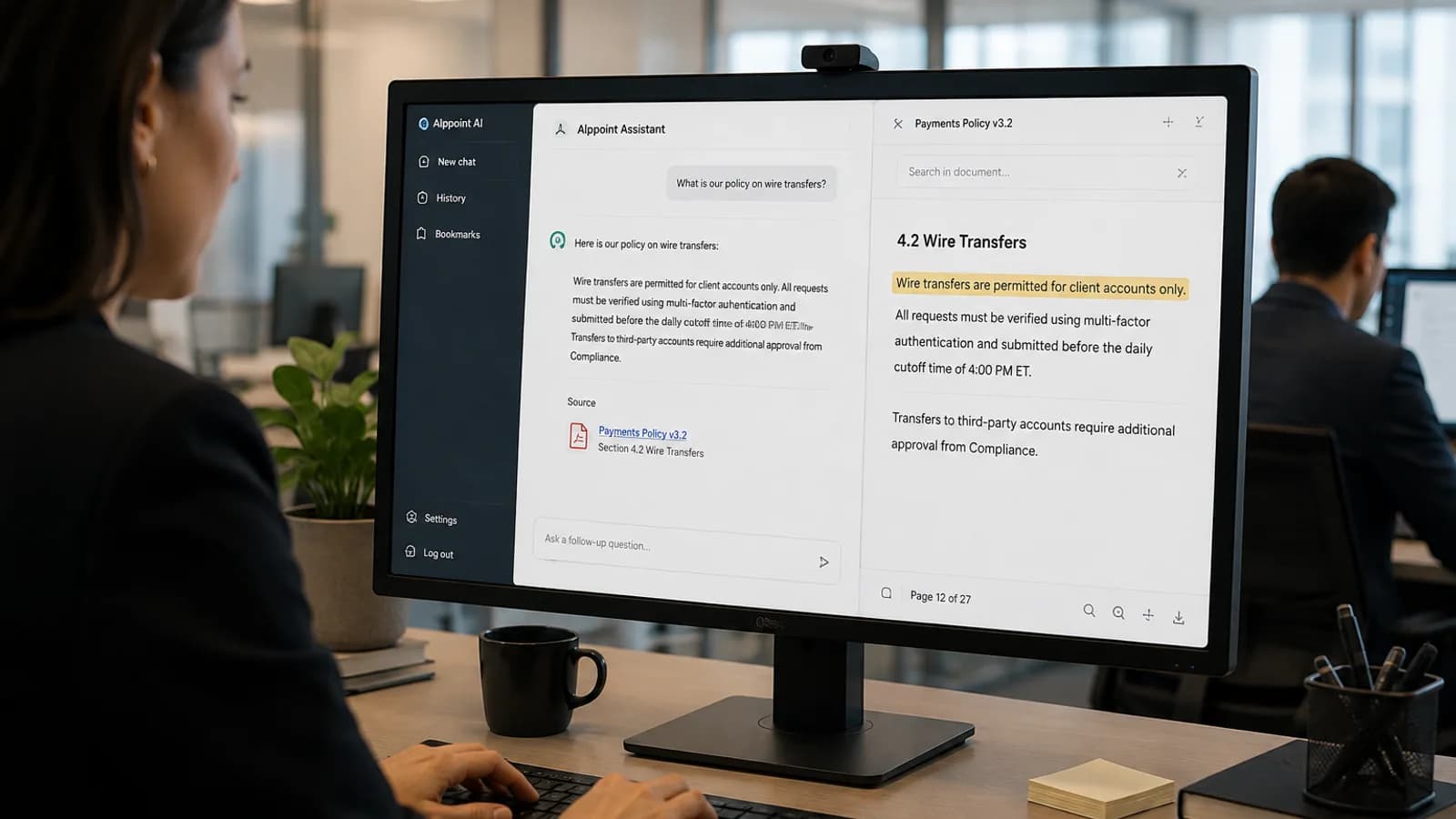
Policy and procedure questions: Answering policy questions from a firm's own documents
Staff ask in plain language and get an answer from the current compliance document, with the passage it came from underneath it.
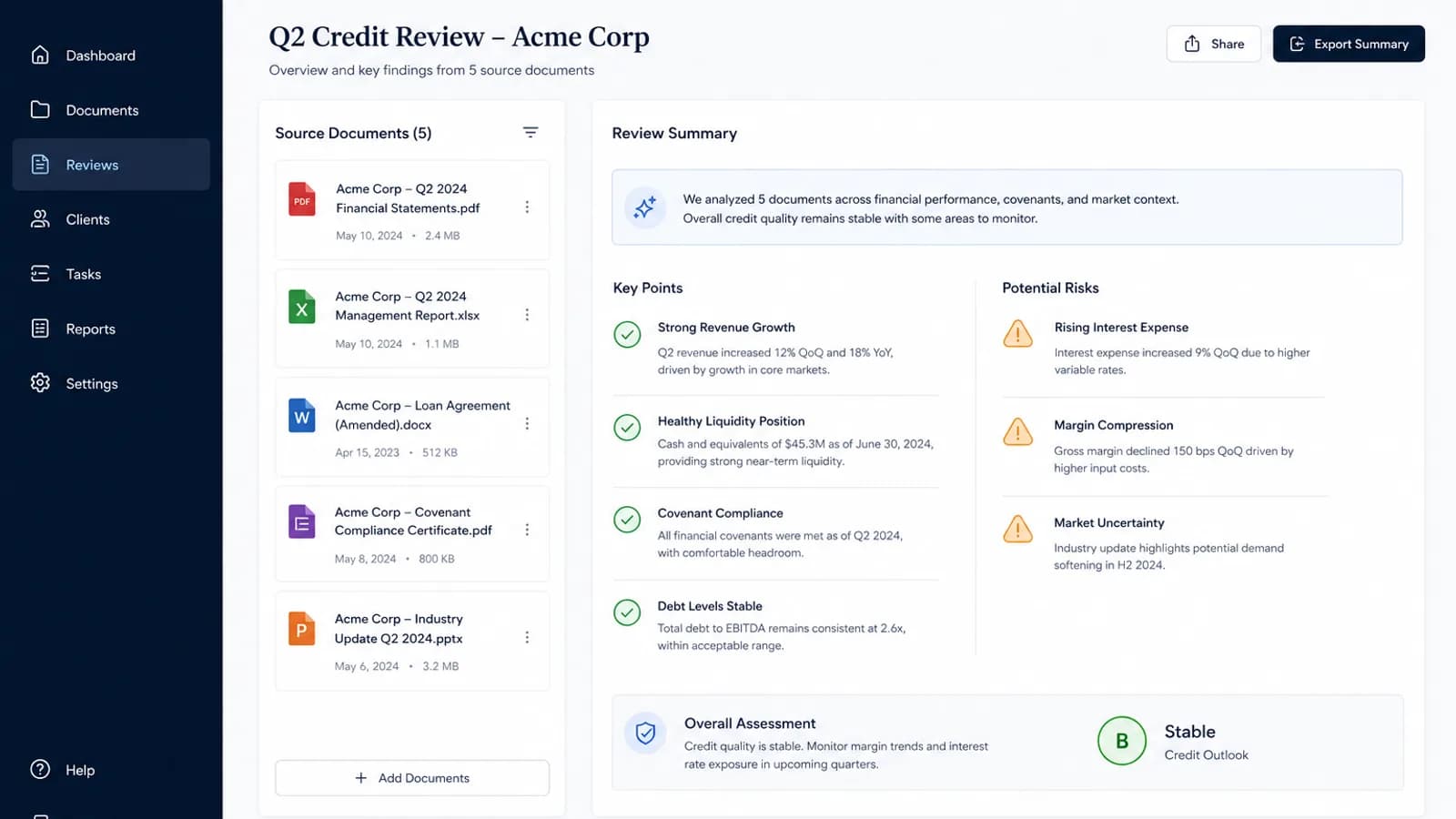
Audit and review preparation: Assembling review-ready summaries from source documents
Source documents summarized into the evidence set a reviewer works from, each item checkable against the original it came from.

Client answers outside office hours: Always-on client support from a firm's own documents
Routine client questions answered from the firm's own service guides and onboarding material, at any hour.

Internal process questions: Answering internal process questions through a chat assistant
Onboarding steps, approval routes and escalation paths answerable in chat, drawn from procedures the firm already wrote.

Knowing what AI is already running: Putting an owner against every AI system in a bank
One record of every AI system in the estate, each with a named owner, a risk tier and a note of the data it can reach.
What running this in a regulated firm takes
These are not added at the end. They are the reason the build takes the shape it does.
- Your permissions, checked when the question is asked
- Access is evaluated for the person asking, in your own systems. Nobody sees a passage they could not have opened directly.
- A source under every answer
- Document, section and a link back. An uncited answer cannot be reviewed, and an unreviewable answer is not usable here.
- A record of what was asked and answered
- Every question, every response and every source used, kept so the system can be examined afterwards rather than trusted in advance.
- Your documents are not used to train a model
- They are retrieved for a single answer and passed as context. Processing location and retention are agreed in writing first.
Questions we get from financial services firms
No. The system runs on your accounts, in your cloud, and reads from where your documents already sit. Where a frontier model is called, the processing location and the retention period are agreed in writing before anything is sent, and they go into the build documentation rather than staying in a conversation.
It uses them. Permissions are read from your existing systems and evaluated for the person asking at the moment they ask, rather than copied into the AI system where they would drift out of date. Recreating an access model in a second place is the failure we design around.
The inventory of what runs and who owns it, the record of what was asked and answered with the sources used, the evaluation set the system was scored against before launch, and the written scope of what it will not answer. We do not certify anything against a framework, and we do not claim compliance on your behalf.
We can own the whole project, deliver one scoped workstream, or put engineers inside your team, working in your repositories and to your review process. Each is tied to a named system reaching production. In each case, you need someone who decides which document is authoritative and who owns the workflow.
Name one workflow worth putting into production
Tell us which process costs your team the most time and which documents hold the answers. We will tell you what it would take to build, and how we would prove it works.